

Gardener Cook
life is good & delicious...

Hello,
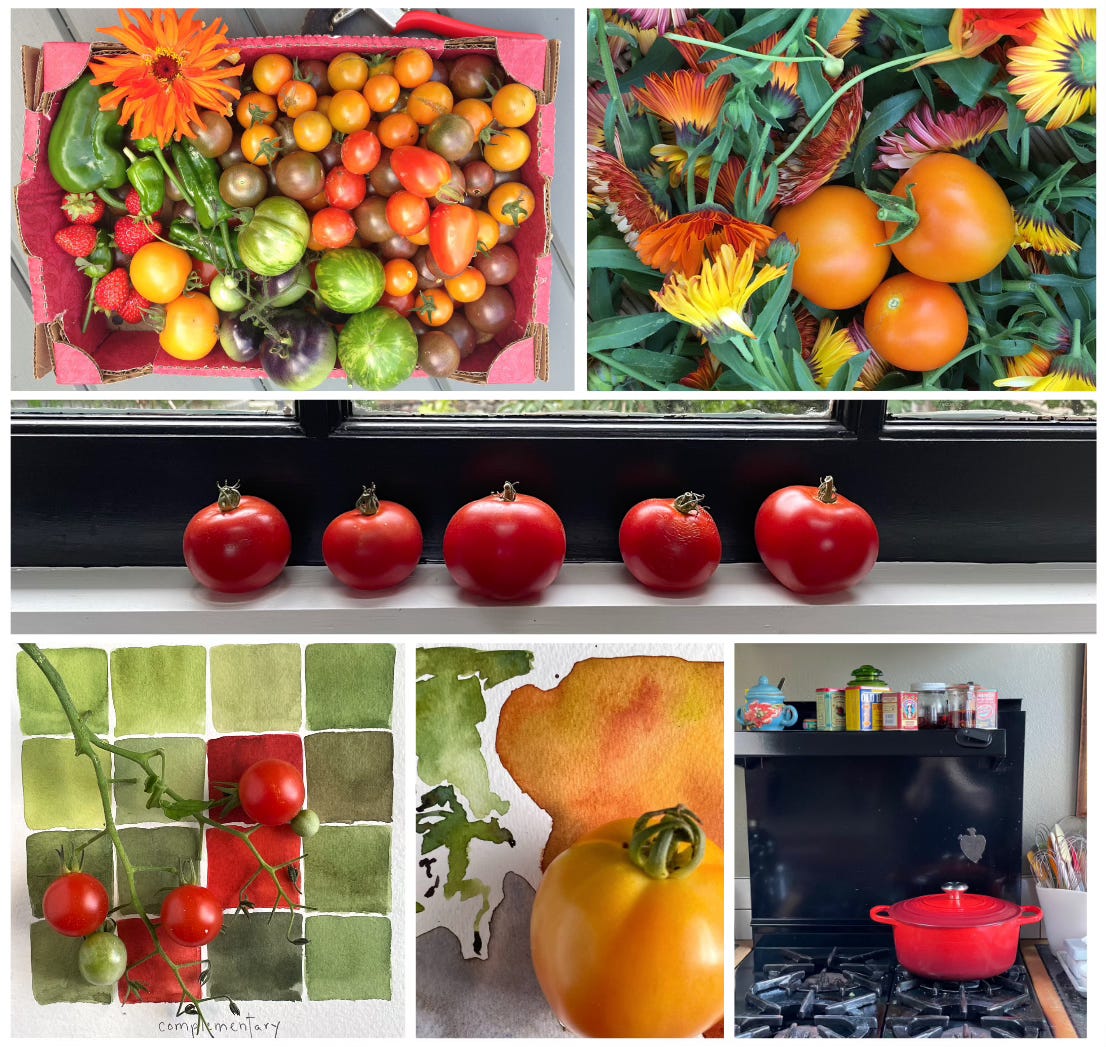
I don’t know about you but I find these dog days of summer to be delicious. Last week I wrote about collecting color names — easy to store, no dusting — but today I want to tell you about another collection: cookbooks. There’s a reason I chose gardener/cook for my long-lost Instagram handle, I love to grow, cook, and eat. Which coincidentally is the title of one of my cookbooks written by my friend Willi Galloway. (An updated edition of Grow Cook Eat publishes early next year. Congrats Willi!) An aside if I may, briefly I considered adopting cook/gardener as my new online identity, but quickly came to my senses to avoid any reference to uh... cannibalism.
One of my favorite food writers is Tamar Adler, author of An Everlasting Meal and creator of The Kitchen Shrink here on Substack. I don’t remember where I saw this quote, it may have been in one of her newsletters, but I quickly wrote it down on a card where it’s become a part of my “index of things I will never let go of.”
“In the kitchen, make the world you long for” – Tamar Adler
Both the garden and the kitchen are stage sets for the transference of energy — from seed to bloom to food to nourishment. Both “feed” me in ways that are a part of the fabric of my daily life.
I’m so glad you’re here,
xo Lorene
In Person
Generation Women, a storytelling event that I’ll be participating in, is fast approaching. The theme for the evening is Flesh & Bone, Stories of the Female Body. Six generations of women, one in their 20s, 30s, 40s, 50s, 60s and 70s will each share a short personal story — it doesn’t get more personal than our bodies. I believe we are our age and all the ones that came before. This should be fascinating and fun.
Details: Thursday, August 22, 2024, 6:30 pm at the Labor Temple in downtown Seattle.
Color Stories
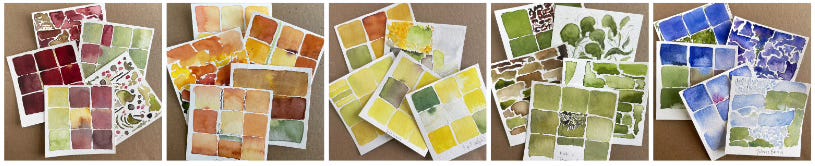
What is a color story? I’m glad you asked. For more than 6 1/2 years I’ve been creating color studies, simple watercolor grids (or not) on small sheets of watercolor paper. In my heart I am a storyteller, so I decided to call these color stories.
Each color story is a collection of nine original 4- by 4-inch watercolor paintings assembled in a unique color palette. That is, each one relates to the others in the set. Some of these color studies are several years old, others may be as recent as last week. These are not precious paintings; they are colorful remnants of my daily practice. Pricing was a challenge until I landed on the idea of assigning value by the square foot, like yardage or carpet only without the commitment. (Nine 4x4” paintings = 1 square foot — $40 or about $4.50/painting) Years ago I installed roughly 300 color studies on the walls of my bedroom; that’s around 36 square feet — but no pressure. *wink
You can frame your paintings individually or in multiples, pin them to your bulletin board for a dose of daily color, or use them as notecards and share them with others. It’s always a bit nerve wracking to introduce new work — I can’t wait to hear what you think.
Sample images are for illustration purposes only.
Quantities are limited. And as a subscriber to this newsletter, you’re the first to know.
Colorful
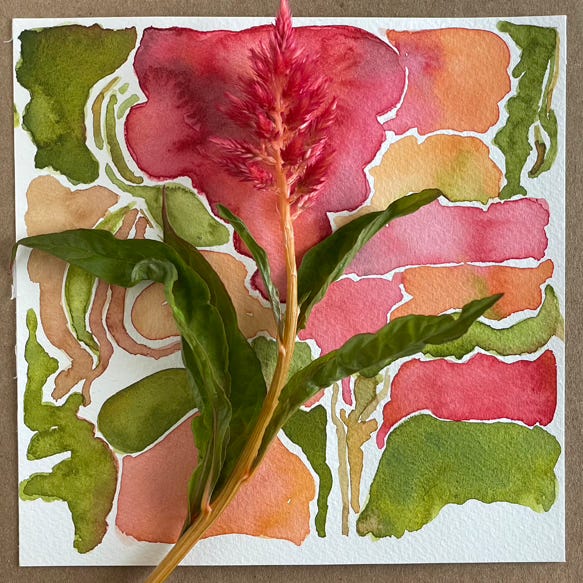
There’s nothing subtle about this tiny Celosia ‘Rose Gold’ from Floret. This is my first time growing this plant from seed and I’m totally smitten with its showy attitude—those melon-colored stems and papaya-pink blooms with mustard olive foliage is like a botanical fruit punch.


Cinnamon Summer
If you know someone who might like a weekly dose of color, click the button below to find out all the ways that you can share a handmade garden with others. The more the merrier.
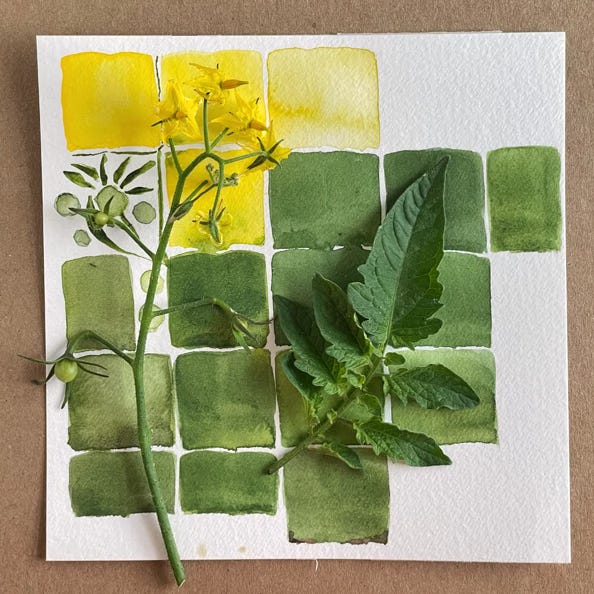
Yesterday I wrangled and pruned the tomatoes in an effort to gently direct the plants’ energy toward ripening fruit. As much as I love ripe tomatoes still warm from the sun, my favorite part may be the bittersweet herbal stink of the sticky foliage. A very seasonal fragrance unique to backyard plots.
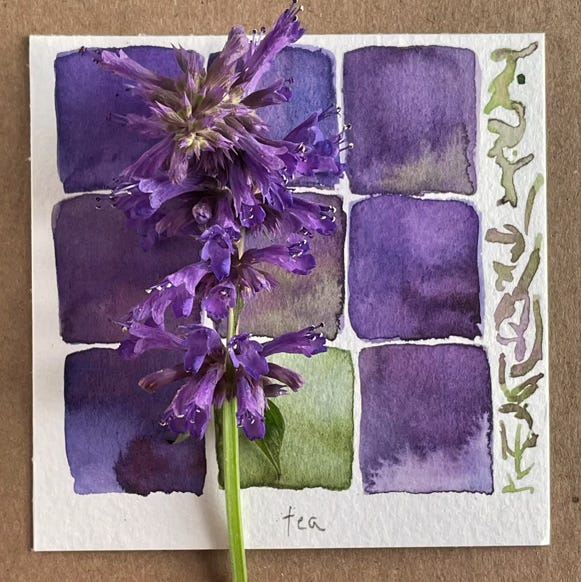
I harvest the leaves and blossoms of anise hyssop (Agastache foeniculum) for each year’s batch of garden-grown tea, a sippable signature of the passing season.


The flower sheds all its petals and finds its fruit
— “Fireflies” by Rabindranath Tagore
Foliage and fruit of Rosa glauca
Years ago I found this fragment of calligraphy in a bright orange frame in a thrift store in Portland. When I looked for a possible source for the phrase, Google turned up Rabindranath Tagore, an Indian poet and his epic poem that goes on and on and on filled with brief but sometimes brilliant aphorisms. Like this one.


To walk through the front garden these days you need to find your way through a small forest of Verbena bonariensis, their scratchy, stiff stems popping up and through wherever they please. I don’t try to rein them in but wait to see where they might insert themselves. Every year is different
This plant holds so many memories for me, including a simple planting that stopped me in my tracks nearly 30 years ago. Made up of only two plants, it was and is one of the most beautiful compositions that I’ve ever seen with purple blossoms of the verbena atop tall waving stems rising from a ground plane of wispy blond hair grass. It’s not lost on me that both of these plants are considered invasive and weedy in some regions, but I love them still. Weeds will always show up, I’m just selecting mine for good company.
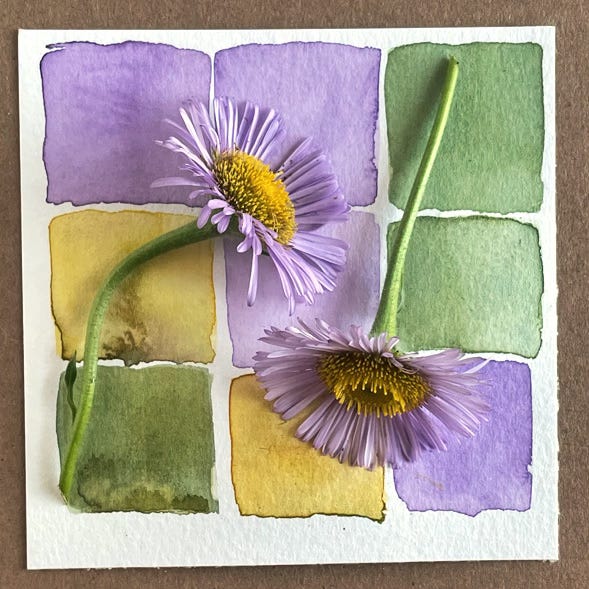
The Hospitality of Native Plants
With ease and natural grace, native plants ground the garden, establishing a belonging that extends beyond planting beds and property lines. With every bloom they declare: This is my place. These are my creatures. We belong here. While deeply wild in the truest sense of the word, many native plants have a domestic side and play nicely with non-natives in mixed plantings.
Seaside daisy is an American west coast native groundcover. A low cushy mound with evergreen foliage, the plant produces nearly constant waves of semi-double lavender blooms with sunny yellow centers from mid-spring to late summer. Like its common name suggests, seaside daisy thrives in coastal conditions, tolerating wind, salt spray, and dry growing conditions. Butterflies and other pollinators flock to the nectar-rich blossoms. Later in the season, juncos and finches swoop in to harvest the seed heads.
— From Color In and Out of the Garden, my book of colors, personal essays, and plants
Totally got me with your Cook/Gardener quip! I laughed out loud! Isn't that Celosia ‘Rose Gold’ pretty! I will be looking for it next spring. I was given a large outdoor container of an unusual mix of many annuals/perennials that were left-overs at a nursery. Since it was mid-fall, I brought it inside to live by a bright window through the winter. One of the plants was a very vigorous Verbena that took over the other nearby planters! It quite liked being a house plant.
Gorgeous gorgeous palettes of Nature - so beautiful, Lorene